
How to read food labels: a simple, practical guide
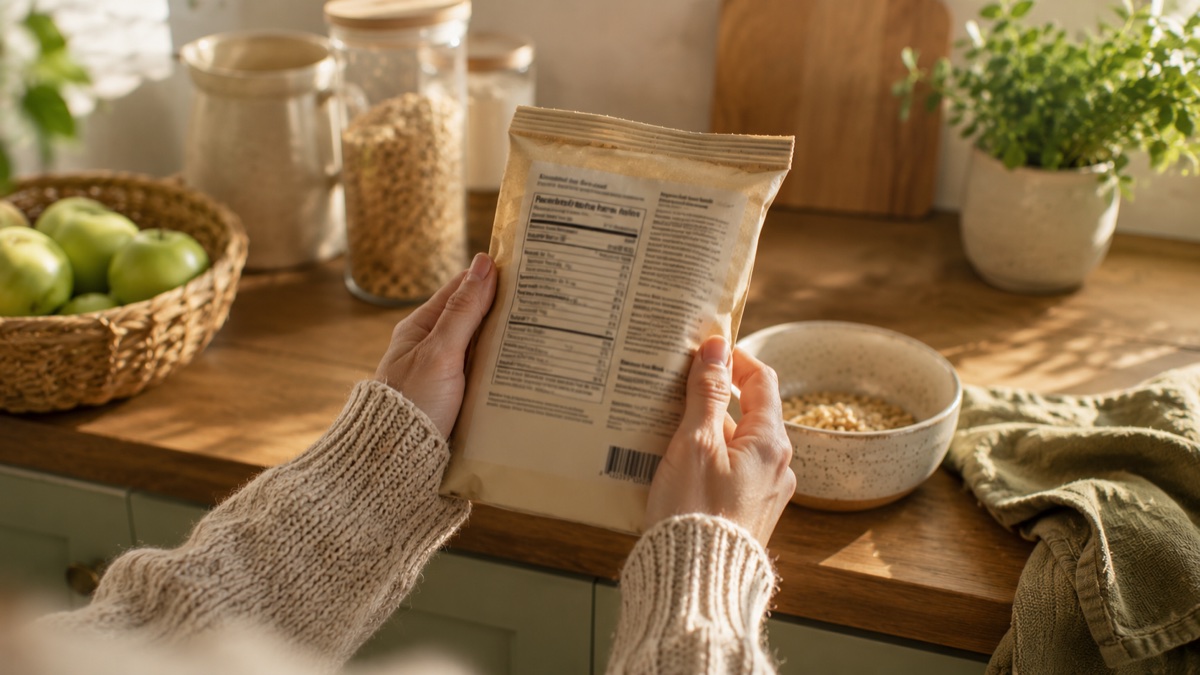
A food label can feel like it's designed to confuse you — and sometimes it is. But the food you buy is the raw material your body rebuilds itself from, so it's worth a quick look, and you don't need to decode every number. A handful of habits let you glance at almost any package and know whether it's a solid choice, in about ten seconds. Here's how to read labels with confidence instead of guilt.
Per 100 g vs per serving
This is the trick that catches most people. Labels show nutrition two ways: per serving and per 100 g (or 100 ml). Manufacturers can set the "serving" tiny to make numbers look better — half a cookie, a small handful of chips. To compare two products fairly, use the per 100 g column, which is a level playing field. To judge how much you'll actually eat, check the serving size and be honest about how many servings that really is.
Ingredients are listed by weight
The ingredients list follows one simple, powerful rule: items are ordered from most to least by weight. So the first two or three ingredients make up the bulk of the food. If sugar, refined flour or oil sits near the top, that's what you're mostly eating. It's also where sugar hides under other names — see our guide to hidden sugar in food for the full list of aliases. A quick read of the top three ingredients tells you more than the marketing on the front of the pack ever will.
📱 Want this on your phone? The free K Lab app gives you an assessment, a meal plan and a symptom tracker.
Download the app →Check the sugar and salt
Two numbers give you the fastest read on a processed food. For a rough traffic-light sense per 100 g:
- Sugar: around 5 g or less per 100 g is low; over ~22.5 g is high;
- Salt: around 0.3 g or less is low; over ~1.5 g is high (salt is sometimes listed as sodium — multiply sodium by 2.5 to get salt).
These aren't hard limits, just a lens. A jar of sauce that's high on both is worth swapping for a lower one; the brands vary far more than the price suggests.
Long lists and quick habits
A very long ingredients list, full of names you don't recognize, usually signals a more ultra-processed food. That's not automatically "bad," but as a rule of thumb, fewer and more recognizable ingredients tend to mean less added sugar, salt and filler. One specific red flag worth learning: "partially hydrogenated oil" means industrial trans fat, which the World Health Organization has urged countries to eliminate — if you see it, put the product back. Three habits that take seconds each:
- Flip the pack over — ignore the front-of-pack claims ("natural," "light," "high protein") and read the actual panel;
- Read the first three ingredients and the sugar and salt per 100 g;
- Compare one rival brand on the shelf — you'll often find a clearly better option for the same price.
Do this a few times and it becomes automatic — you'll shop faster, not slower.
Evidence-based PDF guides — anti-age, gut health, detox and more. Get them free, straight to your inbox.
Browse the guides →Frequently asked questions
Should I read per 100 g or per serving?
Use per 100 g to compare two products fairly, since serving sizes are set by the manufacturer and can be unrealistically small. Use the serving size to judge how much you'll actually eat.
What does the order of ingredients mean?
Ingredients are listed from most to least by weight, so the first few make up the bulk of the food. If sugar, refined flour or oil appears near the top, that is what you are mostly eating.
Is a long ingredients list bad?
Not automatically, but a long list of unfamiliar names usually signals a more ultra-processed food. As a rule of thumb, fewer and more recognizable ingredients tend to mean less added sugar, salt and filler.
Skip the label-reading altogether
The free K Lab assessment turns your goals and tastes into a plan and shopping list built from whole, minimally processed foods — so you spend less time decoding packages and more time eating well.
Get K Lab on your phone
A free assessment, a 7-day meal plan, symptom and habit tracking — in English, Spanish and Russian.
Free to download — no card needed to start.
This article is educational and not medical advice. If you have a condition that requires specific limits on sugar, salt or other nutrients, follow your doctor's guidance. Using K Lab does not create a doctor–patient relationship. Full medical disclaimer.